
A side sleeper's pillow needs to do one thing above all else: fill the entire gap between your ear and the mattress so your head stays level with your spine instead of dropping toward the bed. That means side sleepers generally need a taller, firmer pillow than back or stomach sleepers — and the right height depends on your shoulder width and how much your mattress lets your shoulder sink, not on what the label says.
Below: how to work out your own height, what firmness and materials actually change, the shoulder problem pillows alone cannot fix, and how to tell when the pillow you own has stopped working.
Why side sleeping puts more demand on a pillow
Lie on your side and the geometry is obvious. Your shoulder rests on the mattress and your head is suspended several inches above it. Nothing supports that gap except the pillow.
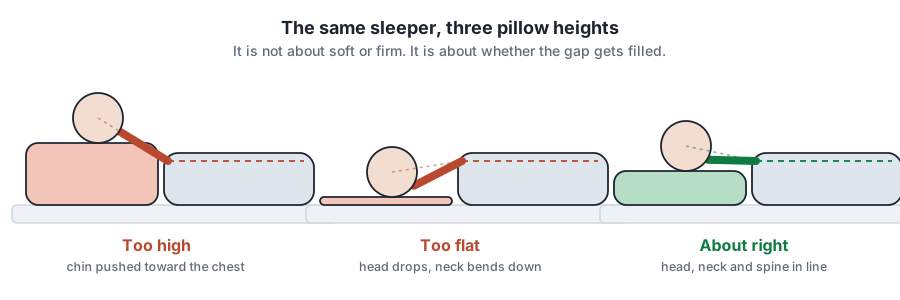
If the pillow is shorter than the gap, your head sags toward the mattress and your neck bends sideways all night. If it is taller, your head is levered upward and your neck bends the other way. Both are sustained sideways bends held for hours, which is why side sleepers with the wrong pillow so often wake with a stiff, one-sided neck that loosens as the morning goes on.
Back sleeping is forgiving because the gap is small. Side sleeping is not, which is why it is worth getting deliberately right.
Finding your height
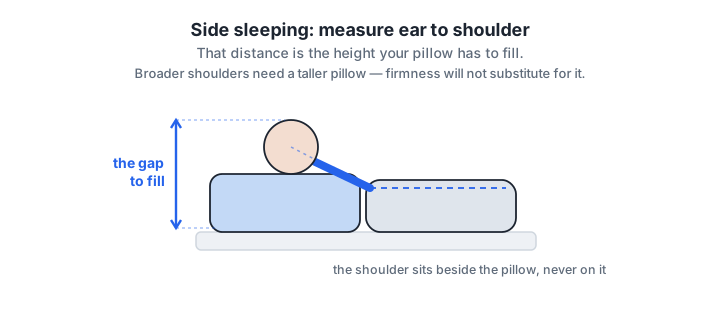
The number that matters is the distance from the outside of your shoulder to the side of your head, measured while lying on your own mattress — not standing, and not on the floor. A soft mattress lets your shoulder sink in, shrinking that distance, so the surface you sleep on is part of the measurement.
The most reliable check does not involve a tape measure at all:
1. Lie on your side on your own bed with your current pillow. Wait a minute or two so any foam or fibre compresses the way it will overnight.
2. Have someone take a photo from the front, at roughly the height of your head.
3. Look at two things in the photo. Is the line of your neck level with the line of your spine, or is your head tilted up or down? And is your nose roughly in line with the centre of your chest?
4. Check your top shoulder. If it is rolling forward across your body toward the mattress, your pillow is almost certainly too low.
Head tilting down toward the mattress means you need more height. Chin tucking toward your chest means you need less. Broader shoulders push the requirement up; a narrow frame or a very plush mattress brings it down.
If you are unsure or between heights, an adjustable pillow — one where you can add or remove fill — lets you find your own number over a week or two instead of buying a series of fixed pillows and hoping.
Firm, soft or extra firm: which one works on your side
Height on the shelf is not height under your head. A tall but soft pillow compresses within minutes and leaves you sleeping on something much lower than you bought.
For side sleeping, that makes firmness a support issue rather than a comfort preference: the pillow has to hold its height for hours under load. Medium-firm to firm generally does; very soft pillows generally do not, however good they feel at first.
A practical test at home, before the return window closes: lie on it in your normal position for a couple of minutes and see how far it sinks. What matters is where your head settles, not how the pillow feels to your hand.
Which pillow shape works best for side sleeping
Height and firmness decide whether the gap gets filled. Shape decides whether it stays filled when you move, and it is the part most people never think about.
- The standard rectangle. Nothing wrong with it if the height is right, but it has one weakness on your side: the edges taper. Roll toward the edge in the night and you drop an inch or two without waking up. It works best for people who stay put.
- Gusseted. A rectangle with a fabric panel stitched around the side, so the pillow keeps a squared edge rather than sloping away. For side sleeping that panel is doing real work — it holds the height at the exact place your shoulder meets it.
- Contoured or cervical. A raised roll along one edge and a hollow in the middle. The idea is that the head settles in the hollow and the roll supports the curve of the neck, so the head cannot drift out of position. The height is set rather than adjustable, so it is worth checking the dimensions against the gap you measured earlier.
- Butterfly or wing shapes. A contour with cut-outs at the sides, meant to give the arm and the shoulder somewhere to go rather than forcing them under the pillow or across the chest.
- Wedge and body pillows. Different job. A wedge raises the whole upper body, usually for reflux or breathing rather than neck alignment, and a body pillow controls what your top arm and leg do. Neither replaces a head pillow.
If you wake up in the same position you fell asleep in, shape matters less than height. If you move a lot, a squared or contoured edge is what stops the height you paid for disappearing at 3am.
What each material actually changes
- Memory foam (solid block). Holds its height consistently and does not need re-fluffing, which suits side sleepers well. The trade-offs are that it is not adjustable, some versions sleep warm, and a solid block gives you exactly one height whether that is yours or not.
- Shredded memory foam. Usually adjustable — you can remove fill to lower it — and generally breathes better than a solid block. Slightly less consistent in feel, and it can need occasional redistributing.
- Latex. Springy and supportive, holds its height well, and tends to be durable. Heavier and typically more expensive.
- Down and down alternative. Comfortable but compressible, which is the wrong property for side sleeping. Usually needs frequent re-fluffing to keep any height at all.
- Contoured or cervical shapes. Built with a raised edge and a hollow for the head, intended to keep the neck supported without letting the head drift. Whether the contour matches your body is individual, and contoured pillows often feel strange for the first few nights. Our Derila review looks at one widely advertised contoured memory foam pillow in this category and what its shape is designed to do.
No material fixes a wrong height. A firm pillow that is two inches too short will still leave your head sagging — it will just do it more stubbornly.
The shoulder problem a pillow cannot solve on its own
Many side sleepers wake up with a sore shoulder rather than a sore neck, and this one is not primarily about the pillow. When you lie on your side, your full upper-body weight presses down through the shoulder that is against the mattress.
Two things help more than a new pillow:
Mattress softness at the shoulder. The shoulder needs somewhere to sink. On a very firm mattress it cannot, so the pressure concentrates. A softer surface or a topper often does more for shoulder pain than any pillow change.
Positioning the arm. Sleeping with the lower arm trapped underneath your body compresses it. Bringing that arm out in front of you and hugging a second pillow keeps the shoulder in a more open position, and stops the top shoulder rolling forward across your chest.
A gusseted pillow — one with a side panel, so the edge stays tall rather than tapering — is also worth considering, since it keeps its height right where your shoulder meets it. And some side-sleeper pillows have a cut-out at the bottom edge specifically to give the shoulder somewhere to go.
If shoulder pain is persistent, wakes you repeatedly, or comes with weakness or numbness in the arm, that needs a doctor rather than a bedding change.
A pillow between the knees
This is not about the neck, but it is worth two lines because it costs almost nothing. Side sleeping lets the upper leg fall forward and rotate the pelvis, which twists the lower back. A pillow between the knees keeps the hips stacked and the spine straighter. Many side sleepers who fix their neck alignment and still wake up with a sore lower back find this is the missing piece.
Why pillows go flat, and which ones hold out longest
Every pillow loses height. What changes between them is how fast, and whether it happens over years or over the course of a single night.
There are two separate kinds of flattening, and confusing them is why people buy the wrong replacement.
Nightly compression is the pillow sinking under your head within minutes and staying down until morning. A pillow that measures four inches on the shelf and two inches under your head was never a four-inch pillow for you. This is a firmness problem, and no amount of fluffing fixes it — you are simply sleeping lower than you think.
Permanent collapse is the material giving up over months: fibre clumping, foam losing its rebound, down migrating to the edges. This is the one people notice, usually far too late.
Side sleepers feel both faster than anyone else, because they have the biggest gap to fill and the least tolerance for losing height. Broadly, solid foam and latex hold their height longest, shredded foam sits in the middle and needs occasional redistributing, and down or fibre goes first. A flat pillow is fine for stomach sleeping and a genuine problem on your side.
One thing worth saying plainly: a pillow you have to fold in half, stack on another one, or punch into shape every night is not a pillow with a technique problem. It has already failed, and you have been compensating for it.
When to replace what you have
Pillows fail gradually, which is exactly why people keep sleeping on dead ones. Signs it is time:
- You fold it in half and it stays folded instead of springing back
- There is a permanent dip where your head goes, or foam that no longer returns to shape
- You find yourself folding it, stacking it, or punching it into position every night
- You wake up stiffer than when you went to bed, on a pillow that used to be fine
- It is visibly stained or has an odour that survives washing the cover
There is no fixed expiry date — a dense latex or foam pillow tends to outlast a fibre one substantially — but if you have been resettling it every night for months, it has already told you.
If you have broad shoulders
This is the single biggest reason two people who sleep the same way need completely different pillows, and the reason generic advice fails so often.
The gap your pillow has to fill is roughly the distance from the outside of your shoulder to the side of your head. Broader shoulders mean a bigger gap, which means more height — sometimes considerably more than a standard pillow provides. If you have broad shoulders and have worked through several pillows without ever finding one that felt right, the likeliest explanation is that none of them was tall enough, not that you are difficult to please.
Two adjustments help before you buy anything taller:
Check your mattress first. A firm mattress refuses to let the shoulder sink, which keeps the gap at its maximum. A softer surface lets the shoulder drop in and shrinks the gap the pillow has to cover. Broad shoulders on a firm mattress is the hardest combination to fit, and changing the surface can matter more than changing the pillow.
Look at an adjustable pillow. If you need more height than most pillows are built for, a shredded-fill pillow you can add to is a more reliable route than hunting for a fixed pillow that happens to be tall enough.
A narrow frame has the opposite problem, and it is just as real: most pillows sold for side sleeping will be too tall, pushing the chin toward the chest all night.
Sharing a bed: two people, two heights
Couples often buy a matching pair of pillows, then one of them wakes up sore. The reason is simple: the pillow has to fill the gap between the shoulder and the head, and two people rarely have the same shoulder width or the same favourite position.
- Measure each person separately, using the method above, rather than buying one height for the bed.
- The broader-shouldered side sleeper usually needs the taller pillow. A back sleeper sharing the bed usually needs a lower one.
- A contour pillow with two edge heights can solve this inside a matching pair, because each person can turn it to the edge that fits them.
In our own house, two Derila Ergo pillows share a double bed, and a third sits on our daughter's bed. Choosing per person, not per bed, is the habit worth copying.
Frequently asked questions
How high should a pillow be for a side sleeper?
Should a side sleeper's pillow be firm or soft?
Is memory foam good for side sleepers?
Why does my shoulder hurt when I sleep on my side?
How do I know if my pillow is too low?
Do I need a pillow between my knees?
How often should I replace a pillow?
Is one side better to sleep on than the other?
What type of pillow is best for side sleepers?
What shape of pillow is best for side sleepers?
Is an extra firm pillow better for side sleeping?
Why do my pillows go flat so quickly?
Do broad shoulders need a higher pillow?
Written by the Sleep Health Editorial Team. This article is based on documentary analysis of publicly available sleep-health and ergonomics guidance. It is general information, not medical advice, and it does not diagnose or treat any condition. Persistent neck or shoulder pain, or any tingling, numbness or weakness in the arms or hands, should be assessed by a qualified healthcare professional.
Still deciding between pillows?
If you are at the stage of choosing rather than reading, our Derila Ergo vs Melara Max comparison puts two contour pillows side by side on price per pillow, materials and the actual refund terms — and says plainly which one we own and which one we only researched.
Compare the two →Thinking about a contour pillow?
We have been sleeping on one every night since March 2026. Our Derila Ergo review covers what the shape actually does for your neck, what it costs, and what the return terms really say — with our own photographs.
Read the review →