Derila Ergo Pillow Review: Six Months of Sleeping On It, Honestly
Our editor has slept on the Derila Ergo every night since March 2026 — roughly six months, on her own bed, in her own bedroom. This review is built on that, not on a spec sheet: what the shape actually does for your neck, how long it takes to stop feeling strange, and what we would tell a friend who asked whether it is worth the money.
Prices rechecked October 2, 2026 • $9.95 shipping • 60 days to open a return

Six months on the Derila Ergo: what actually happens
Two nights of "this feels odd", and then it stopped being a thing we noticed. Since then: a full night through, no rolling around hunting for a cool spot, and no stiff neck in the morning. Our editor sleeps on her side and on her front, switching several times a night, and the pillow handles both without being rearranged. If you sleep mostly on your side, our guide to choosing a pillow for side sleepers explains how to find your height.
What makes it work
The neck cradle holds, instead of collapsing. This is moulded memory foam, so the dip under your head keeps its depth all night. On a soft pillow your head sinks by 2am and your neck spends five hours bent; here it does not, and that single difference is why the morning stiffness goes.
The cut-out wings are the underrated part. Those scooped sides are not decoration. If you sleep on your side or your front, you can slide your arm underneath the pillow instead of trapping your shoulder, and rest your cheek in the recess rather than mashing your face flat. That is what makes a contour pillow survivable for a front sleeper — and it is the detail almost every review skips.
It fits the same way every night. No punching it into shape, no folding it in half. You lie down and the head and neck land where they are supposed to.
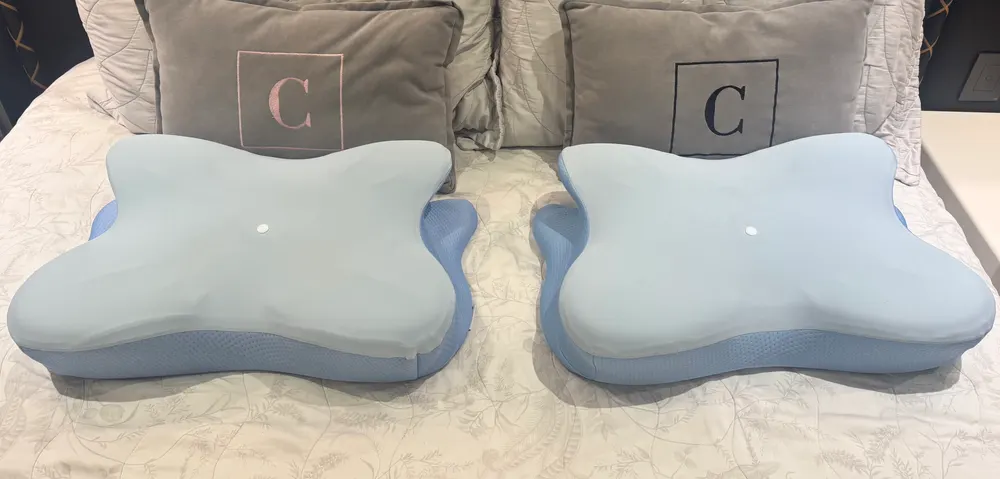
Our own two Derila Ergo pillows, photographed on the bed they are used on. The scooped sides are where your arm and cheek go.
Would we buy it again? Yes — and that is the part worth weighing more than any spec. After six months there is no urge to go back to a normal pillow, which is not something we can say about most of the contour pillows we have looked at.
Prices rechecked October 2, 2026 • $9.95 shipping • 60 days to open a return
What the Derila Ergo actually is
It is a butterfly-contour memory foam pillow. Instead of a flat rectangle, it has a dipped center for your head and two raised "wings" at the front that sit toward your shoulders. The idea is simple: a flat pillow lets your head sink and tilt, which leaves your neck bent at an angle for hours. A contoured shape tries to fill the gap between your head and the mattress so your neck stays closer to neutral. Our guide to choosing a pillow for neck pain walks through firmness, shape and height in more detail.
The official page lists it at 54 cm long by 36 cm wide (21.2 by 14.1 inches) in premium memory foam, with what the brand calls advanced cooling technology in the cover.
Best for: back and side sleepers who wake up with a stiff neck and suspect their pillow is the reason.

One size note that catches people out: at 21.2 inches long it is smaller than a standard US bed pillow. That is normal for a contour pillow, but it will look undersized in a standard pillowcase and on a wide bed. If you want it to look like the rest of your bedding, it will not.
What the first week on a Derila actually feels like
Almost every early return of a contour pillow happens for the same reason: it feels wrong on night one, and people assume it is defective. It usually is not. Your neck has spent years sinking into a flat pillow, and a shaped one holds it somewhere new.
Nights 1–2
Firm, and oddly high. You will catch yourself trying to punch it into shape out of habit. This is the only genuinely awkward part — for us it lasted about two nights.
Nights 3–5
The foam warms to you and the height stops registering. This is when the morning neck stiffness started easing for us, and when sleeping through the night became normal again.
Nights 6–7
By now you know. Either you have stopped thinking about the pillow — which is the goal, and where we landed — or the shape is simply wrong for your build.
Give it five to seven nights before you judge it — that is the seller's own figure too: its official page says the full benefit typically shows up "within 5-7 nights as your body adapts". If you are still fighting it after two weeks, the loft is wrong for your shoulder width and no amount of adjusting will fix that.
What actually changes about how you wake up
You do not lie there feeling a pillow work. What you notice is the absence of things: no stiff neck to roll out of, no arm gone dead under your head, no waking at three to flip and start again. Six months in, the mornings simply stopped being an event.

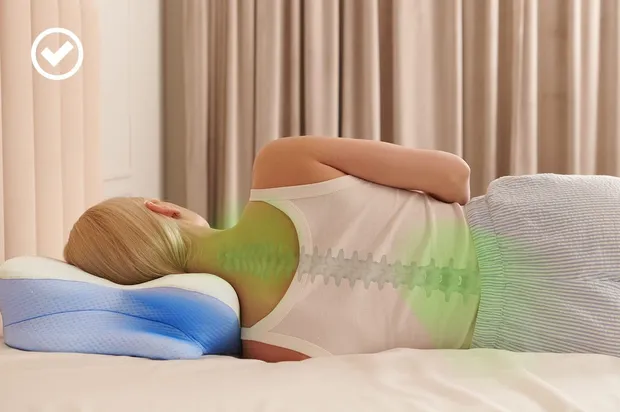
That is the whole mechanism, and it is worth being clear that it is a mechanical one rather than anything medical: your neck is not being treated, it is being held somewhere better for seven hours. When the position is right, the muscles are not bracing all night — and not bracing all night is what you feel at 7 a.m.
What we can tell you honestly: our editor sleeps through the night now, moves between her side and her front without rearranging anything, and gets up without the stiff neck she used to take to the kitchen every morning. That is one person over six months, not a clinical result — but it is a real one, and it is more than most reviews of this pillow can say.
How to use it properly
Most of the "it hurt my neck" complaints come down to using it upside down or too far up the bed. The deeper hollow goes under your head; the two raised wings face toward your shoulders, not underneath them. Your shoulder should sit just off the edge of the pillow, not on it.
On your back: settle your head into the central dip so the raised edge supports the curve of your neck.
On your side: shift onto the higher outer section, which is built to fill the taller gap between your ear and your shoulder.
On your front: this is where the cut-outs earn their keep, and where we expected the pillow to fail. Our editor sleeps partly on her front and it works: you slide the arm under the scooped side and let your cheek settle into the recess, so your head is supported without your neck being cranked around. It is not a flat pillow and it never will be — if you sleep face-down and totally flat, with your head turned hard to one side, you will still find this tall. Try it on the scooped side before you decide it is not for you.

Who it is for, and who should skip it
Worth buying if…
- You sleep on your back, on your side, or move between the two during the night
- You wake up with a stiff neck and suspect your pillow
- You run warm at night
- You want more than one and the per-pillow price appeals
- You are happy to commit before opening the packaging
Skip it if…
- You like a soft pillow you can fold in half, punch and reshape — this one holds its shape by design
- You want to sleep on a pillow for a month and then send it back; the return runs on unopened packaging
- You are looking for a medical device rather than a comfort and posture product
Official page • the four-pack works out to $39.99 a pillow
Is Derila legit, and is it any good?
The company publishes its shipping, return and refund terms openly, and all three are linked from the checkout page. That is where the details live — delivery windows, what a return requires, how refunds are processed — and they are worth two minutes of your time before you pay, the same as with any online order.
Two practical things to settle before you order, and both are covered further down this page: which bundle you want, and how the return works if you change your mind. Decide those two and the rest of the checkout is straightforward.
Buy from the page you clicked through, and check the domain in the address bar. Derila is sold through several different storefronts, and this matters more than it sounds: the seller's own policy states that it "only offer[s] this 60-day returns policy for physical products purchased on this website", and that anything bought from other sellers is governed by that seller's policy instead. The link on this page goes to get-derila-ergo.com, which is the storefront the terms quoted further down belong to. Whichever review site you read next, check which domain it is actually rating before you let it decide anything for you.
One note on the reviews you will see on the official site: the seller states that every customer gets an automated survey invitation after delivery, which is a normal and disclosed practice. It does mean those reviews capture the first impression rather than how the pillow feels months later — which is exactly the gap this page is here to fill, since ours is now six months old and still holding its shape.
What it costs right now
One pillow is $59.99. The four-pack is $159.96, which works out to $39.99 each — the cheapest way to buy it. Standard shipping adds $9.95 and the checkout notes that taxes may apply, so a four-pack lands at roughly $169.91 delivered.
Two honest notes on this table. First, the crossed-out "regular" prices are the seller's own reference figures, not a price this pillow has been selling at recently — judge it on the real number, not the discount. Second, the checkout runs a countdown timer on the offer; the discount has been there every time we have looked, so do not let the clock rush your decision.
See the current bundle prices →Official page • prices and shipping change, confirm before you pay
The return policy, in plain English
This is the part we think is worth more than anything else on this page, because it is the one thing almost no other Derila review spells out — and it is the difference between a purchase you can undo and one you cannot.
What the published policy actually says
You get 60 days to open a return, which is generous on paper. But the conditions are specific, and they are quoted directly from the seller's own return page:
In practice that means a change-of-mind return needs the pillow unopened and in its original packaging, you must request an RMA number and wait for it before shipping anything back, you pay the return postage, and the refund is issued within 14 days after the parcel is received and inspected, then takes another 3 to 5 business days to show on your statement.
So here is what to actually do about it. Treat the 60 days as time to make up your mind, not time to test the pillow. Before you order, measure the gap between your ear and the edge of your shoulder when you lie on your side — that gap is what the pillow has to fill, and it tells you more about whether a fixed contour height will suit you than any review can. If you are unsure whether you will get on with a contour shape at all, buy the single pillow first at $59.99 rather than committing to the four-pack, and add the extras later once you know.
What we rechecked in October 2026
On October 2, 2026 we went back to the official checkout and the seller's policy pages and checked every number on this page again.
- Prices: unchanged. $59.99 for one pillow, $99.98 for two, $137.97 for three, $159.96 for four ($39.99 each).
- Return window: unchanged. Still 60 days from delivery, still the same conditions quoted above.
- One correction to our earlier wording. We had written that refunds take 14 business days. The policy says the refund is issued within 14 days of the parcel arriving, and the bank then needs 3 to 5 business days. We have fixed it above.
If you want the whole return process with a clock on each step, from the first form to the money back in your account, we laid it out on our Derila price page.
Worth saying plainly: the policy page never uses the words "sleep trial" or "risk-free". Where you see those phrases attached to Derila, they come from marketing pages, not from the terms you agree to at checkout. We would rather you hear that from us now than discover it later.
Does it help with snoring or sleep apnea?
"Derila pillow for sleep apnea" is one of the most searched phrases about this product, so here is the honest answer. Snoring often has a positional component: when your head tips back or rolls forward, the airway narrows. A contour pillow holds your head in a more neutral position, and plenty of people do find that light, positional snoring settles down because of it. That is a real and welcome side effect of better alignment.
What it is not is a treatment. Sleep apnea is a medical condition and no pillow diagnoses or treats it. If you snore heavily, wake up gasping, or feel wiped out after a full night in bed, that deserves a proper look from a doctor — a better pillow can make you more comfortable in the meantime, but it is not a substitute for finding out what is going on.
Six months in: has it gone flat?
This is the question we would have asked before buying, and it is the one a review written after a week cannot answer honestly.
The short version: no, not in the way a fibre pillow goes flat.
Solid memory foam does not behave like loose fill. There is nothing inside to clump or migrate to the corners, because the pillow is one moulded block. It either holds its shape or the foam itself degrades, and that is slow. After six months of nightly use, ours still comes back to its shape by morning and the contour is still where it was in March.
What has changed, and it is worth being straight about: the foam has softened slightly. In the first few weeks it felt firmer than it does now. That is normal for memory foam and it is not the same thing as collapsing — the height is still there, it simply yields a little more readily than it did on night one. If anything we find it more comfortable now than at the start.
What we can tell you is exactly what six months of nightly use looks like, because that is what we have done with it. It has not gone flat, and the shape is still doing in September what it was doing in March.
Looking after it
The one rule that matters: wash the cover, never the foam. Submerging a memory foam block breaks down its structure and it does not recover, so it does not go in the washing machine and it should not be soaked to spot-clean either.
In practice that means using a pillowcase over the cover, taking the cover off to wash it on the setting its own label specifies, and letting the foam air out uncovered for a few hours now and then. Let the cover dry completely before it goes back on.
We can be specific about how that has held up, because it is the part of a pillow people regret not asking about. We keep two covers in rotation and both have been through the machine repeatedly over these six months. Neither has shrunk, faded, or changed how it fits — the zip still closes the same way it did in March. A cover that shrinks is what turns a good contour pillow into a lumpy one, so this matters more than it sounds.
Pros and cons
What it gets right
- The bundle price is genuinely good. At $39.99 a pillow on the four-pack it comes in well under a single pillow at full price, and cheaper per unit than the Melara Max we put it against in our head-to-head comparison.
- The shape suits the two most common sleep positions. Back and side sleepers are exactly who a butterfly contour is designed for, and that is most people.
- Sixty days is a long window, and it is written into the terms. The 60 days sits in the published return policy rather than only in the advertising — keep the packaging intact and you have two full months to change your mind.
- Cooling is built into the cover, not sold as an add-on. The brand specifies what it calls advanced cooling technology in the cover. That is the seller's own spec rather than a lab result, but it is on the spec sheet — which is more than most contour pillows at this price bother to claim.
- Normal payment options, not a sketchy checkout. The official checkout takes PayPal, Apple Pay and the four major cards, which is a basic but real signal: this is a working storefront, not a fly-by-night page.
- The delivery window is published, not vague. The shipping policy commits to roughly 4 to 14 business days after a 1 to 2 day processing window, so you can plan around it instead of guessing.
- It holds its shape night after night. This is moulded memory foam, not shredded fill in a bag — it springs back to the same contour every morning instead of flattening into a pancake the way a soft pillow does after a few months.
What to know before you buy
- Shipping is $9.95 and is not refunded. What to do: factor it in up front — on a single pillow it is a real 17% on top of the price, which is another argument for the multi-pack if you were already considering one.
- It has a fixed height — there is no adjusting it. What to do: if you like a very flat pillow, use the scooped side rather than the centre, and give it the full week before judging; if you still want flat after that, this shape is not going to become flat.
Cheapest at $39.99 a pillow on the four-pack • + $9.95 shipping
Frequently asked questions
Is the Derila Ergo pillow legit or a scam?
How much does the Derila Ergo pillow cost?
Can I return the Derila pillow after sleeping on it?
Does the Derila pillow help with sleep apnea?
How do you use the Derila Ergo pillow?
Do normal pillowcases fit the Derila Ergo?
Can you sleep on your stomach with the Derila Ergo?
How big is the Derila Ergo pillow?
Two nights to adjust • decide before you unwrap it
The strongest thing we can tell you about it
Everything above is one household’s experience, and you should weigh it as that. But there is one fact that says more than any paragraph we could write: we now own three of them.
Two live on the double bed. The third was bought separately, later, for our daughter’s single bed — and that one was not bought to be written about. It was bought because the first two had already done their job for months, and because you do not put a pillow on your own child’s bed on the strength of a sales page.
That is also the honest reason the four-pack keeps coming up in this review: buying more than one is what we actually did, and at $39.99 a pillow it is the version of this purchase that makes sense once you know the shape suits you.
The bottom line
Six months on, this is the pillow we still reach for. If you wake up with a stiff neck and you sleep on your side, your back, or somewhere between the two, it is an easy recommendation — and at $39.99 a pillow on the four-pack it costs less than one night of bad sleep is worth. Give it two nights to stop feeling strange, add the matching covers to your order, and decide before you unwrap it rather than after.
Get the Derila Ergo →Official page • prices rechecked October 2, 2026 • shipping $9.95, taxes may apply