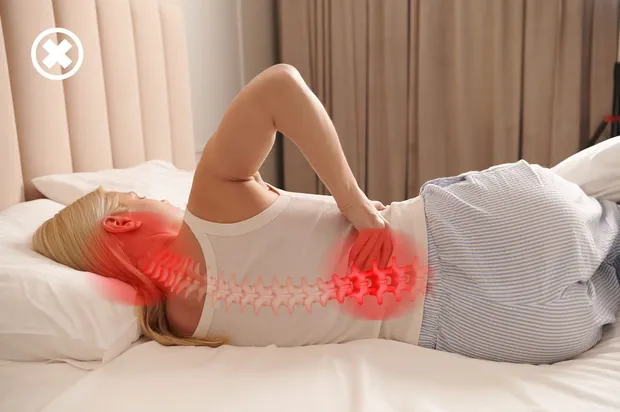
If your neck hurts most in the first hour after waking and eases as the day goes on, the pillow is the first suspect. Not the only one, but the first. A neck held at an angle for seven hours protests when you finally move it, and the angle is set almost entirely by the height of what is under your head.
This guide is about choosing the pillow, not diagnosing the pain. If you want the causes first, our article on waking up with neck pain covers those. Here we work through what actually matters in a pillow for a sore neck, in the order it matters, so you can choose once instead of three times.
What a pillow has to do for a sore neck
One thing: keep your head level with your spine, all night, in the position you actually sleep in.
That sounds obvious and it is where most pillows fail. Level does not mean high or low, soft or firm, foam or feather. It means that if someone photographed you asleep, the line of your neck would continue the line of your back rather than bending up, down or sideways. Every feature worth paying for serves that one goal, and every feature that does not serve it is marketing.
It also has to keep doing it at 3am. A pillow that is level at bedtime and half its height by the small hours has done nothing for you, because the hours that count are the ones you are not awake to notice.
Start with how you sleep, not with the pillow
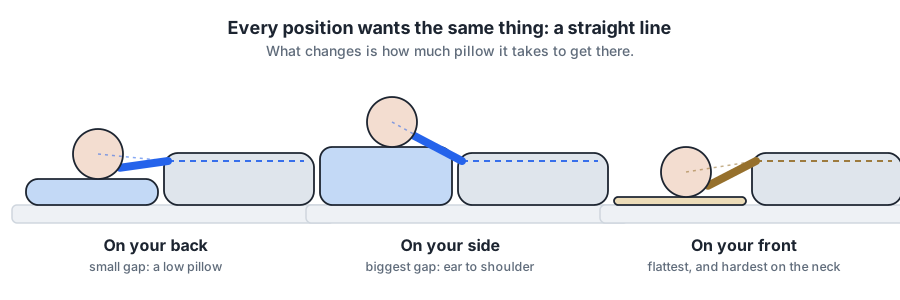
The right height is set by your sleeping position more than by anything else, which is why a pillow that cured a friend’s neck may do nothing for yours.
- Side sleepers need the most height, because the pillow has to fill the whole gap between ear and shoulder. Too low is the usual mistake, and broad shoulders push the requirement up further. Our guide to the best pillow for side sleepers works through the measurement.
- Back sleepers need a medium height that supports the curve at the back of the neck without pushing the chin toward the chest. Too high is the usual mistake here, and it is the one that produces the stiff, forward-bent neck on waking.
- Stomach sleepers need the least height, often almost none, because the head is already turned to one side. Most pillows sold for neck pain are too tall for this position.
- Combination sleepers who move between positions need a pillow that works in two of them, which usually means a side-sleeper height with a shape that still supports the neck on the back.
If you are not sure which you are, you are almost certainly a combination sleeper, and the position you wake up in is the one that matters most. Our article on sleeping position and pillow height has a simple at-home way to find your own number.
Firmness is a support question, not a comfort one
Height on the shelf is not height under your head. A tall, soft pillow can compress to half its size within minutes and leave you sleeping on something far lower than you bought. For a sore neck, that quietly recreates the problem you were trying to fix.
So firmness here means one thing: does the pillow hold its height under the weight of your head for a full night? Medium-firm to firm generally does. Very soft generally does not, however good it feels to the hand. Very firm does not help either, because beyond holding height it only adds pressure at the ear and jaw.
A practical test before any return window closes: lie on it in your normal position for a few minutes and check where your head has settled, not how the pillow feels when you press it.
Shape: flat, contoured or adjustable
A flat rectangle works if the height is right and you sleep still. Its weakness is that the edges taper, so if you roll toward the edge in the night you lose height without waking.
A contoured pillow has a raised roll along the edge and a hollow for the head. The roll supports the curve of the neck and the hollow stops the head drifting. For back and side sleepers with neck pain this is often the shape that helps most, because it addresses the two things a sore neck needs: support under the curve and no movement out of position. The height is set, so it is worth checking the dimensions against your own frame before buying. We have been sleeping on one every night since March 2026, and our six-month review of a contoured pillow covers what the shape does and what it costs.
An adjustable pillow lets you add or remove fill until the height is yours. For someone who has already bought two wrong pillows, this is the safest route, because it turns a guess into a week of small corrections.
Material: what actually changes
- Memory foam. Holds its height consistently and moulds to your shape, which is exactly the property a sore neck needs. A solid block is a fixed height; shredded fill can be adjusted. Our guide to whether memory foam pillows are good covers where the material helps and where it gets in the way.
- Latex. Springy, supportive and durable. Holds height very well. Heavier and usually more expensive, and it gives a bouncier feel some people find less settling than foam.
- Down and feather. Comfortable and compressible, which is the wrong combination for neck pain. It needs constant re-fluffing to hold any height, and it will not hold it through the night.
- Polyester fibre. Inexpensive and initially fine, but it clumps and flattens within months. If your current pillow is fibre and more than a year old, it may be the whole problem.
No material fixes a wrong height. A firm pillow that is two inches too short still leaves the head dropping. Choose the height first, then the material that holds it.
What the first week is like
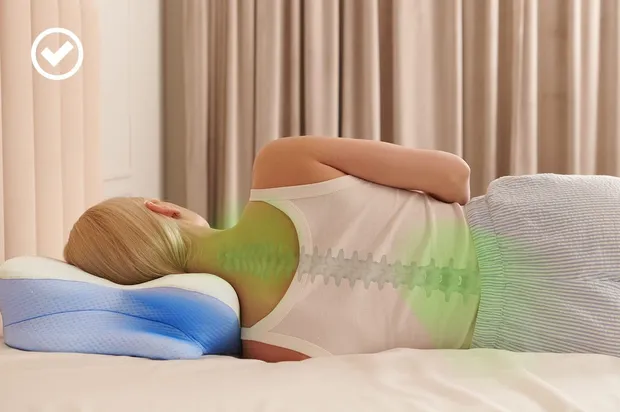
This is the part nobody warns you about. A pillow that properly supports your neck usually feels wrong for the first two or three nights, particularly if you have spent years on one that collapses. Your neck has adapted to being unsupported, and support feels like an intrusion until it does not.
Give it five to seven nights before judging. The signal to watch is the morning: if the stiffness is clearly less by the end of the first week, the pillow is working and the odd feeling will pass. If mornings are worse after a week, the height is wrong for you, and the direction of the wrongness tells you which way to go. Chin pushed toward the chest means too high. Head dropping toward the mattress, or a hand creeping under the pillow in the night, means too low.
What no pillow will fix
A pillow addresses the angle your neck holds while you sleep. It does not address a mattress that lets your shoulders and hips sink unevenly, a habit of reading in bed with the head propped forward for an hour, or a day spent looking down at a screen. It also does not address pain that is there all day rather than worst on waking.
If your neck pain is constant, followed an injury, spreads into an arm, or comes with tingling, numbness or weakness in the hands, that is a doctor’s question rather than a bedding one, and worth asking sooner rather than later.
Frequently asked questions
What kind of pillow is best for neck pain?
Should a pillow for neck pain be firm or soft?
Is a high or low pillow better for neck pain?
Can a pillow actually cause neck pain?
How long does it take for a new pillow to help neck pain?
Is a contoured pillow good for neck pain?
Are memory foam pillows good for neck pain?
When should I see a doctor about neck pain?
Written by the Sleep Health Editorial Team. This article is based on documentary analysis of publicly available sleep-health and ergonomics guidance. It is general information, not medical advice, and it does not diagnose or treat any condition. Persistent neck pain, or any tingling, numbness or weakness in the arms or hands, should be assessed by a qualified healthcare professional.
Comparing two contour pillows?
Our Derila Ergo vs Melara Max comparison puts two contoured memory foam pillows side by side on price per pillow, materials and the actual refund terms — and says plainly which one we own and which one we only researched.
Compare the two →What six months on one looks like
We have been sleeping on a contoured memory foam pillow every night since March 2026. Our Derila Ergo review covers what the shape does for your neck, how you wake up on it, what it costs and what the return terms really say — with our own photographs.
Read the review →