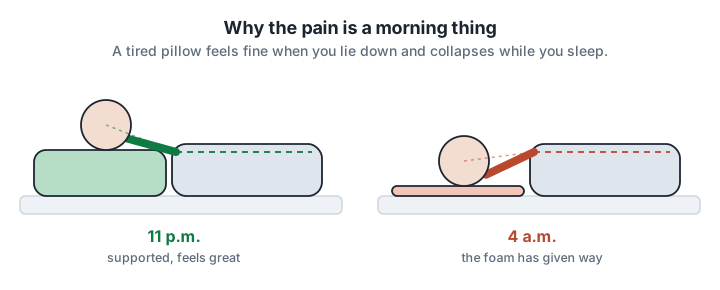
Memory foam is the default recommendation for anyone with neck trouble, and like most defaults it is right often enough to be repeated and wrong often enough to be worth examining. It is not a better material than latex or down in any absolute sense. It is a material with one specific strength and four specific weaknesses, and whether it suits you comes down to which of those apply to how you actually sleep.
Here is what it does under your head, which of the common complaints hold up, how long these pillows really last, and who should buy something else.
What memory foam actually is
Memory foam is a polyurethane foam engineered to be viscoelastic, which is a technical way of saying it responds to pressure and heat rather than pushing straight back the way a spring does. Press it and it yields slowly, spreading your weight across the contact area instead of concentrating it. Take the pressure off and it returns to shape slowly too.
For a pillow that produces two effects that matter. The foam moulds around the shape of your head and neck rather than making you conform to it, so support follows your own contour. And it holds the height it moulds to, because there is no loose fill inside to shift, clump or migrate to the corners.
The temperature sensitivity is the part people notice first without knowing what it is. Foam is stiffer when cold and softer as it warms, which is why a memory foam pillow can feel unyielding in the first minutes and quite different twenty minutes later. In a cold bedroom that transition takes longer.
Solid block or shredded fill
These are sold under the same name and they behave differently enough that choosing wrong is one of the more common ways people end up disappointed.
- A solid block is one moulded piece. Support is completely consistent, it never needs redistributing, and it holds its shape indefinitely. The catch is that it gives you exactly one height, forever. If that height is not yours, nothing can be done about it.
- Shredded fill is the same foam torn into pieces inside a case. Most versions open so you can take fill out or add it, which means you can tune the height to your own shoulder width over a week or two. It also breathes better, because air moves between the pieces. The trade-off is that it is slightly less consistent underfoot, and the fill occasionally needs redistributing by hand.
The short rule: if you already know what height works for you, a solid block is simpler and more reliable. If you are guessing, shredded is far more forgiving, because it lets you correct a wrong guess without buying a second pillow.
What memory foam does well
It holds its height. This is the whole case for the material, and it is a strong one. A down or fibre pillow that measures four inches in the shop can be sitting at two inches under your head within minutes, and you never notice because it happens while you are falling asleep. Foam does not do that. The height you lie down on is roughly the height you wake up on, which is exactly what your neck needs across seven unconscious hours.
It spreads pressure. Because the foam moulds to your shape rather than resisting it, contact is distributed rather than concentrated in a few spots. Side sleepers tend to feel this at the ear and jaw, where a firm conventional pillow can create a genuine pressure point.
It is stable. Nothing inside migrates. No re-fluffing, no folding it in half to get height back, no waking to find the fill has all gone to one end.
It resists dust mites reasonably well. A dense foam block is a less hospitable environment than loose fill. That is not the same as being hypoallergenic and it does not replace washing the cover, but it is a real difference for some people.
The four complaints, and which are real
1. It sleeps hot. Partly true, and less true than it was. Dense foam does trap body heat, and a solid block has no airflow through it. Manufacturers now address this with perforations, gel infusion, open-cell structures and breathable covers, and shredded fill breathes better than a block by design. If you already sleep hot, treat this as a real constraint and choose a ventilated or shredded version rather than assuming any foam pillow will be fine.
2. It feels firm and strange at first. True, and usually temporary. Part of it is the temperature sensitivity described above, and part is that a new pillow has not broken in. There is a third element people underestimate: if your neck has spent years settling into a pillow that collapses, being properly supported feels wrong before it feels right. Most people stop noticing within one to two weeks, which is why judging a foam pillow after two nights is a bad idea.
3. It smells. This one varies far more by manufacturer than the internet suggests. Some new foam off-gasses on unwrapping, and where it happens the smell fades on its own within days, faster if you leave the pillow uncovered in a ventilated room. But plenty of pillows arrive with no noticeable smell at all — the contoured foam pillow we have been sleeping on since March did not have one. Treat it as something worth checking reviews for on a specific product rather than a property of the material.
4. You cannot adjust it. True of a solid block, and the most important of the four. Every other complaint fades with time. This one does not. A block that is an inch too tall for you will be an inch too tall on night three hundred. This is the reason to measure your own height before buying rather than after, and the reason shredded fill exists.
How long they last
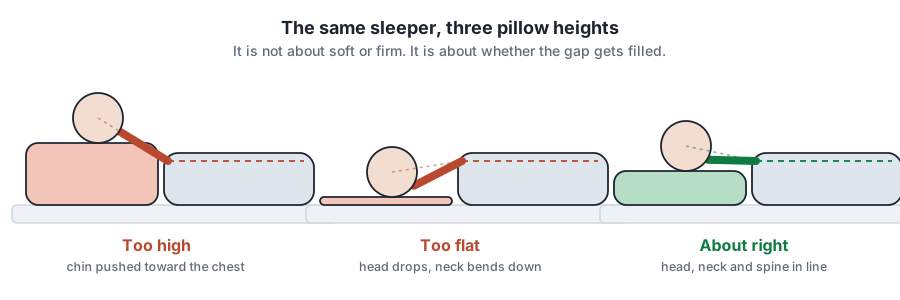
Memory foam generally outlasts fibre and down, for the same reason it supports better: there is no loose fill to break down. What eventually ends its life is the foam losing rebound. It stops returning fully to shape, and a permanent dent forms where your head goes.
There is no honest universal number of years, because it depends on the density of the foam, your body weight, and how warm and humid the room is. Judge it by behaviour instead. It is finished when it holds a permanent hollow, when it no longer springs back after you press it, or when you find yourself rearranging it every night to make it work. A pillow you have to fix nightly has already told you what it is.
Worth separating two things that get confused: a pillow that sinks under your head within minutes every night was too soft from the start, while one that got gradually lower across a year has genuinely worn out. They need different solutions. Our guide to choosing a pillow for side sleeping goes into how to tell them apart.
Flat block or contoured shape
Within memory foam there is a second choice that matters as much as the material: whether the pillow is a plain rectangle or a moulded contour with a raised roll along one edge and a hollow for the head.
The argument for the contour is that it stops the head drifting out of position. On a rectangle, your head can slide toward an edge during the night and lose height without waking you. A contour holds it in the hollow and keeps the neck supported by the roll.
The arguments against are worth knowing before you buy. A contour is a shape someone else designed, so it suits some frames better than others, and it usually takes a few nights before it stops feeling unfamiliar. Most people who give it a week stop noticing it altogether. Sellers who build a contour pillow generally offer a case cut to the same shape, which is worth adding to the same order rather than buying separately later.
If you want to see how that plays out on a specific product over a long period, our six-month review of a contoured memory foam pillow covers what the shape does, what it costs and where it falls short.
Who a memory foam pillow suits
- Side sleepers. The biggest gap to fill between ear and mattress, and the least tolerance for a pillow that loses height. Holding a steady height is precisely what foam does.
- Anyone waking with a stiff neck on a pillow that collapses. If your pillow needs folding or punching to work, a material that keeps its height addresses the actual cause.
- Back sleepers who want neck support, particularly with a contoured shape, where the raised edge supports the curve of the neck rather than leaving it unsupported.
- People who are tired of re-fluffing. Foam simply does not need it.
Who should choose something else
- Front sleepers. Sleeping face-down needs almost no height, and foam holds a height. Most foam pillows push the head too far back for this position, and a solid block cannot be flattened.
- People who sleep very hot and do not want to shop carefully around ventilation. Latex or a well-made fibre pillow may be less trouble.
- Anyone who likes to reshape their pillow. If you fold, punch and rearrange as part of getting comfortable, foam will frustrate you. It refuses.
- Anyone unsure of their height, unless they buy shredded fill. Committing to a fixed height you have not measured is the most common way this purchase goes wrong.
If you are not sure which category you fall into, the deciding factor is usually your sleeping position rather than the material. Our guide to sleeping position and pillow height works through that first, and our article on waking up with neck pain covers the causes that no pillow will fix.
If neck pain is the reason you are shopping, our guide to choosing the best pillow for neck pain starts from your sleeping position rather than from the material, which is the order that avoids buying twice.
What the labels CertiPUR-US and OEKO-TEX actually mean
Two badges come up again and again on memory foam pillows, and they cover different parts of the product.
- CertiPUR-US covers the foam. Certified foams are made without ozone depleters, without PBDE flame retardants and certain Tris flame retardants, and within strict limits for formaldehyde and a list of phthalates, and they are tested for low emissions of volatile organic compounds (under 0.5 parts per million). The testing is done by independent laboratories.
- OEKO-TEX Standard 100 covers textiles, which on a pillow means the cover. It certifies that the fabric has been tested for a long list of harmful substances.
Neither badge tells you whether a pillow will suit your neck, and the CertiPUR-US programme itself does not allow brands to call foam "non-toxic" or "chemical-free." What they do give you is a published, testable standard for what went into the foam and the fabric. The Derila Ergo's product images carry both badges.
Source: CertiPUR-US, "About Certified Foam" and the 2025 technical guidelines.
Frequently asked questions
Are memory foam pillows good for your neck?
Do memory foam pillows sleep hot?
How long does a memory foam pillow last?
Why does a new memory foam pillow smell?
Can you wash a memory foam pillow?
Is shredded or solid memory foam better?
Why does a memory foam pillow feel firm at first?
Who should not buy a memory foam pillow?
Written by the Sleep Health Editorial Team. This article is based on documentary analysis of publicly available sleep-health, materials and ergonomics guidance. It is general information, not medical advice, and it does not diagnose or treat any condition. Persistent neck or shoulder pain, or any tingling, numbness or weakness in the arms or hands, should be assessed by a qualified healthcare professional.
Comparing two contour pillows?
Our Derila Ergo vs Melara Max comparison puts two memory foam contour pillows side by side on price per pillow, materials and the actual refund terms — and says plainly which one we own and which one we only researched.
Compare the two →What six months on one looks like
We have been sleeping on a contoured memory foam pillow every night since March 2026. Our Derila Ergo review covers what the shape does for your neck, whether the foam has gone flat, what it costs and what the return terms really say — with our own photographs.
Read the review →