
Waking up with neck pain is usually a positioning problem, not a mystery illness: your head spent six to eight hours at an angle your neck muscles had to brace against, and they stiffened up holding it there. For most people the cause is the sleeping position, the pillow height, or both — but neck pain that keeps coming back for more than a week, or that arrives with tingling, numbness, or weakness in an arm or hand, is a reason to see a doctor rather than a reason to buy a new pillow.
Below: what typically causes morning neck pain, what helps in the first hour, what to change tonight, and the signs that the problem is not your bedding.
Why the pain is worst at 7 a.m. and mostly gone by noon
The pattern almost everyone describes is the same: the neck is stiff on waking, turning the head is uncomfortable, and after a hot shower and a couple of hours of movement it loosens off.
That makes sense mechanically. Sleep is the longest stretch of the day in which your neck holds one position without correction. Awake, you shift constantly, and every small movement redistributes the load. Asleep, those corrections stop. If your head is tilted a few degrees off neutral, muscles on one side spend hours shortened while the ones opposite work to stabilise it, and circulation to the area is lower at rest. The result is the familiar "slept wrong" stiffness that eases once you warm the tissue back up.
The implication is useful: pain that is worst in the morning and improves through the day points toward how you are sleeping. Pain that is worst at the end of the day points more toward your desk, your phone, or your workload.
The most common causes of morning neck pain
Your pillow is the wrong height for the way you sleep
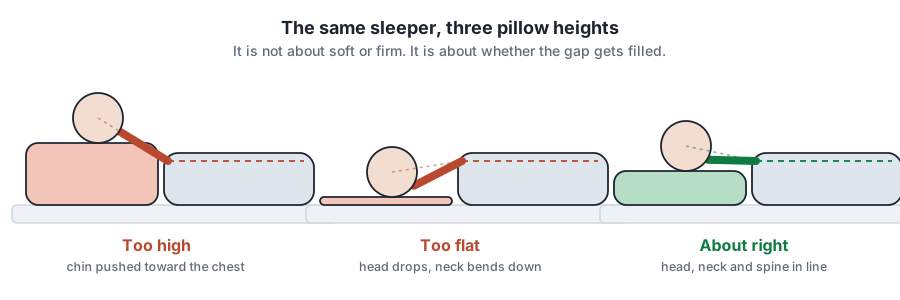
This is the most common cause and the one people are least likely to check. A pillow has one structural job: to fill the gap between your head and the mattress so your neck stays roughly in line with the rest of your spine.
That gap is a completely different size depending on how you sleep. On your side it is as wide as your shoulder — several inches. On your back it is much smaller, roughly the depth of the natural curve at the base of your skull. A pillow that is right for one position is wrong for the other.
When the pillow is too tall, your head is pushed up and your chin drifts toward your chest. When it is too flat, your head drops back. Either one, held for hours, produces exactly the morning stiffness this article is about. Contoured memory foam pillows are a popular attempt to solve this by building support into the shape rather than leaving it to the fill; we look at how one widely advertised version is designed in our Derila review.
You sleep on your stomach
Stomach sleeping is the hardest position for a neck, for a reason that is easy to see: to breathe, you have to turn your head almost all the way to one side and keep it there. It is a rotation you would not hold for two minutes at your desk, sustained for hours. It is also the hardest habit to change, because most people fall into it unconsciously — the section below has a realistic way to approach it.
Your pillow has quietly collapsed
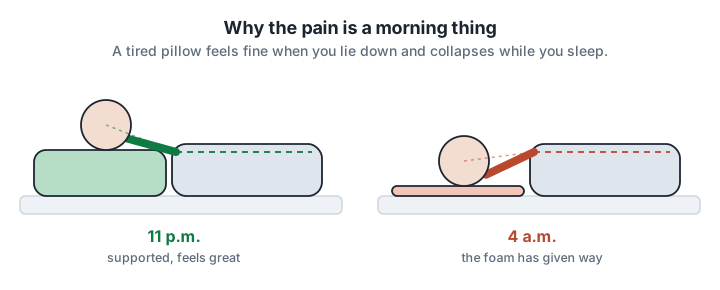
Pillows do not fail on a specific date; they sag gradually, and because the change is slow you adapt without noticing. A pillow that supported your head properly two years ago may now compress to half its height within twenty minutes of you lying down.
A rough test for a fibre or down pillow: fold it in half, hold for a few seconds, and let go. If it springs back, there is still structure in it. If it stays folded, it has lost its resilience. Foam is better judged by feel — a permanent dip where your head goes means it is done.
Tension you took to bed with you
Stress and neck muscles have a well-known relationship, and it does not switch off at bedtime. If your shoulders sit high and tight through a stressful week, those muscles can stay partly contracted overnight. This is one reason morning neck pain sometimes tracks your calendar more closely than your bedding.
An ordinary strain you slept through
Sometimes the neck was already irritated before bed — a heavy bag on one shoulder, a long drive, an evening looking down at a phone — and eight hours of stillness turned that into a painful morning. Here the pillow is not the culprit; it just failed to help.
What tends to help in the first hour
None of this treats an underlying condition or replaces a clinician's advice. These are the ordinary self-care measures widely recommended for a run-of-the-mill stiff neck:
- Move gently, early. Slow, small movements — turning your head side to side, tilting your ear toward each shoulder, shoulder rolls — within the range that does not hurt. Movement is generally more useful than complete rest for muscular stiffness.
- Warmth for a stiff, achy neck. A warm shower with the water on the back of your neck, or a heat pack for fifteen to twenty minutes, helps many people relax tight muscle.
- Cold if it feels acutely inflamed. If the pain came on suddenly and feels sharp rather than stiff, some people prefer a cold pack for the first day. Use whichever gives you relief.
- Do not force the stretch. Pulling your head into a painful range to "crack" the stiffness out tends to aggravate an already irritated muscle.
- Over-the-counter pain relief, if it suits you. Check with a pharmacist or doctor given any other medication or condition, and follow the label.
What to change tonight
Work out which position you actually sleep in. Not the one you fall asleep in — the one you wake up in. That is the position your pillow needs to serve.
Match the pillow height to that position. Lie down as you normally would and have someone look at you from the front or the side. On your side, your nose should be roughly in line with the centre of your chest, your head neither tilting up nor drooping toward the mattress. On your back, your chin should sit close to neutral.
Stop stacking pillows to fix height. Two pillows create a hinge in the middle, and the stack shifts overnight, so the support becomes unpredictable.
If you sleep on your stomach, try a staged change. Start the night on your side with a body-length pillow to hug, which gives your arms somewhere to go and makes rolling face-down less comfortable. If the habit will not shift, a very flat pillow — or none — at least reduces how far your neck has to extend.
Look at where your phone is at 11 p.m. A long stretch of looking down at a screen in bed loads the same muscles that then have to survive the night.
Give any change a week or two before judging it; the first few nights in a different setup often feel odd.
When morning neck pain is not a bedding problem
Most morning neck stiffness is mechanical and settles. Some is not. Contact a doctor if your neck pain comes with any of the following:
- Tingling, pins and needles, numbness, or weakness travelling into your shoulder, arm, or hand
- Pain that follows a fall, car accident, or other injury
- Fever, a severe headache, or a neck so stiff you cannot bring your chin toward your chest
- Pain that wakes you repeatedly at night, or is getting worse rather than better
- Neck pain alongside loud snoring, choking or gasping in your sleep, or heavy daytime sleepiness — sleep-disordered breathing needs proper assessment by a doctor
- Pain that has not meaningfully improved after a couple of weeks of sensible self-care
- Any loss of coordination, balance problems, or changes in bladder or bowel control — these warrant immediate medical attention
None of this is a diagnosis, and no article can tell you which of these applies to you. A pillow is a comfort and positioning product; it is not a treatment for a nerve, disc, or joint problem, and it is never a substitute for getting persistent pain properly assessed.
If the pillow you own is the likely cause and you are weighing up what to replace it with, our guide to whether memory foam pillows are any good covers what that material does well, what it does badly, and who should choose something else.
Once you have a sense of the cause, the next step is choosing a replacement. Our guide to the best pillow for neck pain works through height, firmness, shape and material for the way you actually sleep, and what to expect in the first week.
How to tell whether a change is working
Morning neck pain changes slowly, and memory is a poor judge of slow change. A simple fix: for the next 14 mornings, give the stiffness a score from 0 to 10 within five minutes of getting up, before coffee and before you start moving it around. Write it in your phone's notes alongside one word about the night before (late screen, new pillow, slept on the sofa).
After two weeks, look at the trend rather than any single morning. A drop of two or three points across the fortnight is a real change. A flat line tells you the pillow or position is not the problem, which is useful in its own way: it points you toward the causes in the section above, or toward a professional.
If you are trying a new pillow, start the log a few days before it arrives. Then you are comparing it with your real baseline, not with how you remember feeling.
Frequently asked questions
Why does my neck hurt when I wake up but feel fine by the afternoon?
Can a pillow really cause neck pain?
Should I use heat or ice on a stiff neck?
How long should morning neck pain last?
Is it better to sleep without a pillow if my neck hurts?
Can stress cause neck pain overnight?
When should I see a doctor about neck pain after sleeping?
Reviewed and written by the Sleep Health Editorial Team. This article is based on documentary analysis of publicly available sleep-health and ergonomics guidance. It is general information, not medical advice, and it does not diagnose or treat any condition. If you have persistent or worsening neck pain, or any neurological symptoms, please speak with a qualified healthcare professional.
Thinking about a contour pillow?
We have been sleeping on one every night since March 2026. Our Derila Ergo review covers what the shape actually does for your neck, what it costs, and what the return terms really say — with our own photographs.
Read the review →