
There is no single best sleeping position for everyone, but there is a reliable principle: the best position is the one in which your head, neck and spine stay close to neutral, and that depends far more on your pillow height than on the position itself. Back and side sleeping are both easy to support well; stomach sleeping is the hardest on the neck, because breathing forces your head to stay rotated to one side for hours.
Below: what each position asks of your neck, how to work out the pillow height that suits yours, and how to test the pillow you already own.
The short version
- Side sleeping: needs the tallest pillow, because it has to fill the whole gap between your ear and the mattress — the width of your shoulder.
- Back sleeping: needs a medium-to-low pillow that supports the curve at the base of the skull without pushing the head forward.
- Stomach sleeping: needs the flattest pillow, or none, because any height increases how far the neck has to extend.
- The universal test: lie down as you normally sleep. Your head should feel held, not lifted and not dropped, and your chin should not be tucked toward your chest or tipped back.
Why "neutral" is the target rather than a specific position
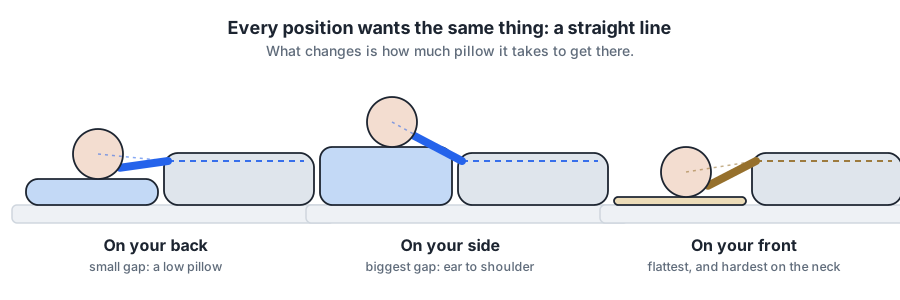
Your spine has natural curves, including one in the neck. Neutral simply means those curves sit roughly where they do when you stand comfortably — the neck neither cranked forward, bent backward, nor bent sideways.
This matters more at night than during the day because of duration. Awake, you correct your position constantly without thinking. Asleep, you do not. Whatever angle your neck settles into is the angle it holds for hours, and tissue held near the end of its range for that long tends to protest in the morning.
So the useful question is not "which position is healthiest?" but "in the position I actually sleep in, is my head being held level?" A well-supported stomach sleeper often does better than a side sleeper with a collapsed pillow.
Side sleeping: the tallest gap to fill
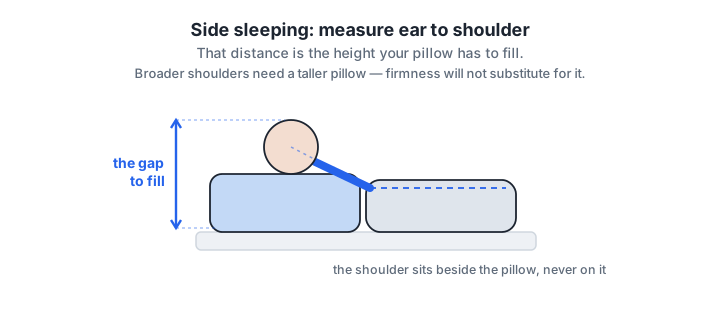
Most adults sleep on their side for at least part of the night. It supports well, with one condition: the pillow has to be tall enough.
Look at the geometry. Your shoulder is on the mattress and your head is suspended several inches above it. The pillow's job is to fill that entire distance so your head stays level with your spine instead of sagging toward the bed.
That distance is personal. Broader shoulders need more height. Your mattress matters too — a soft one lets your shoulder sink in, reducing the gap, so the same person may need a lower pillow on a plush bed than on a firm one.
Signs the pillow is too low include your head tipping down toward the mattress, your upper shoulder rolling forward across your body, and soreness on the underside of your neck. Signs it is too high include your chin tucking toward your chest and stiffness across the shoulders.
If you sleep on your side, our fuller guide to choosing a side-sleeping pillow goes deeper, and for contoured memory foam specifically, our Derila review breaks down how that style of pillow is shaped.
Back sleeping: less height than most people use
Back sleeping is usually the easiest position to support, because the gap is small — roughly the depth of the natural hollow at the base of your skull, not the whole distance to your shoulder.
The classic mistake is using the same tall pillow you use on your side. On your back, that height pushes your head up and forward and holds your chin toward your chest all night. A quick check: lie on your back and look straight up. If you can comfortably see the wall in front of you rather than the ceiling, or you can see your own feet, the pillow is probably too tall.
Two other things help back sleepers more than pillow shopping does. A small pillow or rolled towel under the knees takes tension off the lower back. And if you snore heavily, gasp, or choke during sleep, that is not a pillow problem — it should be discussed with a doctor, because sleep-disordered breathing needs proper assessment.
Stomach sleeping: the hardest one on the neck
Stomach sleeping is the position most commonly flagged as difficult for the neck, and the reason is straightforward. You cannot breathe face-down into a mattress, so your head has to rotate almost fully to one side and stay there — a rotation you would find uncomfortable for a few minutes at a desk, sustained for a whole night.
If you sleep on your stomach and wake up fine, there is no urgent reason to change. If you wake up stiff, two adjustments are worth trying first:
Go flatter. Any pillow height under a stomach sleeper's head adds neck extension on top of the rotation. Many do better with a very thin pillow or none, and a thin pillow under the hips can take strain off the lower back.
Try transitioning to your side. This is genuinely hard, because the switch happens while you are unconscious — a mechanical prop works better than willpower. A body-length pillow to hug gives your arms and knee somewhere to rest and makes rolling face-down less appealing. Expect weeks, not nights.
How to find your pillow height without guessing
You do not need a measuring tape. You need a second pair of eyes or a phone camera.
1. Set up your normal bed. Same mattress, same topper, same pillow. Mattress softness changes the answer, so testing on the floor is misleading.
2. Lie down in the position you actually wake up in. Give it a minute — foam and fibre both compress after you settle.
3. Have someone photograph you from the front for side sleeping, from the side for back sleeping.
4. Look for a straight line. On your side, your nose should be roughly in line with the centre of your chest, and the line from head down spine should be level rather than kinked. On your back, your chin should be neutral — not pressed toward your chest, not tipped back.
5. Check your shoulder if you sleep on your side. If the upper shoulder rolls forward toward the mattress, the pillow is usually too low.
Head tilted up in the photo, try a lower pillow. Tilted down, try a higher one. If you are between sizes, adjustable-fill pillows let you add or remove material until the line is right.
Things that change the answer
- Mattress firmness. A softer mattress lets your shoulder and hip sink, reducing the gap the pillow has to fill. Change your mattress and your pillow height may need to change with it.
- Shoulder width. Broader shoulders need a taller pillow for side sleeping — which is why one pillow rarely suits two people in the same bed.
- Pillow age. A pillow that measured right when new may compress well below that after a couple of years. Height on the shelf is not height under your head at 3 a.m.
- Position changes overnight. If you split the night between your back and your side, a reasonable compromise pillow — or a contoured one offering different heights on different edges — usually beats one optimised for a single position.
- Congestion, reflux, pregnancy, or recent surgery. These can all change what is comfortable or advisable, and your doctor's guidance should override any general article.
Once you know the height your position needs, the next question is what the pillow should be made of. Our guide to memory foam pillows covers where that material helps, where it gets in the way, and the difference between a solid block and an adjustable shredded fill.
Reading or watching TV in bed
A lot of neck strain happens before you fall asleep. Sitting up against a stack of pillows to read or scroll pushes the head forward and down, often for an hour at a time, and the pillow you sleep on was never designed for that angle.
- Raise the book or screen, not your chin. A cushion on your lap, or the device propped against your knees, keeps your eyes level without bending the neck forward.
- Support your lower back first. A firm cushion behind the lower back lets you sit upright, so the head balances over the shoulders instead of hanging forward.
- Swap back before sleep. When you lie down, take the reading pillows away and go back to the one pillow that matches your sleeping position. Falling asleep propped up is how many people wake up stiff.
Frequently asked questions
What is the healthiest sleeping position?
How high should my pillow be?
Is sleeping on your stomach actually bad for you?
Should back sleepers use a thin pillow?
Can I train myself to sleep in a different position?
Does my mattress change the pillow height I need?
Is it bad to sleep with two pillows?
Which side is better to sleep on, left or right?
Written by the Sleep Health Editorial Team. This article is based on documentary analysis of publicly available sleep-health and ergonomics guidance and is general information only. It is not medical advice and does not diagnose or treat any condition. Persistent neck or back pain, numbness or tingling in the arms or hands, or symptoms such as snoring, gasping or choking during sleep should be assessed by a qualified healthcare professional.
Still deciding between pillows?
If you are at the stage of choosing rather than reading, our Derila Ergo vs Melara Max comparison puts two contour pillows side by side on price per pillow, materials and the actual refund terms — and says plainly which one we own and which one we only researched.
Compare the two →Thinking about a contour pillow?
We have been sleeping on one every night since March 2026. Our Derila Ergo review covers what the shape actually does for your neck, what it costs, and what the return terms really say — with our own photographs.
Read the review →